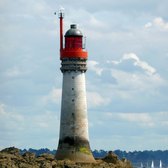
The great tides
The bay of Saint-Malo and Mont Saint-Michel has the strongest tides in Europe. Several times a year the sea withdraws far out, then returns to break against the sea walls.
What a great tide is
The French tidal coefficient measures the difference in water height between high and low water. A great tide begins at a coefficient above 100, the theoretical maximum being 120. The strongest occur around the equinoxes, in late winter and early autumn, a few days after the full or the new moon.
When
Several times a year, for two to four days at a time, mostly around the equinoxes: in late winter (January to March) and in late summer (August to October).
The official dates and coefficients, year by year, are published by the SHOM, the French naval hydrographic service: tide times and coefficients for Saint-Malo. They are known far in advance, which allows you to book early — the great tides fill the town.
From the apartment
The apartment is on the sixth and top floor, facing due south, with a cross view: the Rance estuary and Dinard on one side, Saint-Malo as far as the Pointe de la Varde on the other. During the great tides you can follow the sea retreating across the estuary and then returning, from the living room, without having to find a place along the ramparts.
Where to watch them
- The ramparts of the walled city, 15 minutes on foot: the waves breaking over the sea wall when the wind gets up.
- The beach and the Solidor Tower, 300 metres away: at low water the foreshore is uncovered a very long way out.
- The Rance barrage, visible from the apartment.
Take care. At high coefficients the sea rises quickly and waves come over the sea walls. Keep well back from the parapets, do not walk out onto the foreshore without knowing when the tide turns, and follow the instructions issued by the town.